
Suggestions
Guide for authors
Searcher
Journal Information
Vol. 62. Issue 2.
Pages 75-144 (February 2026)
Cite
Cite
Share
Download PDF
More article options
Vol. 62. Issue 2.
Pages 75-144 (February 2026)
Original Article

Analysis of Effectiveness of Clinical Psychological Care Protocol for Smoking Cessation With Cytisinicline

Visits
3773
Angela Ramos-Pinedoa,
Corresponding author
arpinedo@salud.madrid.org

Corresponding author.
, Jose Ignacio de Granda-Oriveb, Maria Isabel Cristóbal-Fernándezc, Calos Rábade-Castedod, Elia Pérez-Fernándeze, Paz Vaquero-Lozanof, Maria Inmaculada Gorordo-Unzuetag, Lourdes Lázaro-Aseguradoh, Eva de Higes-Martíneza, Juan Antonio Riesco-Mirandai, Rosa Mirambeaux-Villalonaj, Gloria Francisco-Corralk, Alejandro Frino-Garcíal, Jaime Signes-Costa Miñanam, Cristina Villar-Lagunan, Ana Maria Cicero-Guerreroo, Julio Cesar Vargas-Espinalp, Teresa Peña-Miguelh, Jacobo Sellaresq, Carlos Andrés Jiménez-Ruizr
a Unidad de Neumología, Hospital Universitario Fundación Alcorcón, Madrid, Spain
b Medicine Department, School of Medicine, Complutense University, Respiratory Department, 12 of October University Hospital, Madrid, Spain
c Unidad especializada en tabaquismo de la Comunidad de Madrid, Hospital Clínico San Carlos, Madrid, Spain
d Unidad Especializada de Tabaquismo, Servicio de Neumologia, Hospital Clínico Universitario de Santiago de Compostela, La Coruña, Spain
e Unidad de Investigación, Hospital Universitario Fundación Alcorcón, Madrid, Spain
f EPA en Tabaquismo, CEP Hermanos Sangro, Hospital General Universitario Gregorio Marañón, Madrid, Spain
g Servicio de Neumología, Hospital Universitario Galdakao-Usánsolo, Bizkaia, Spain
h Servicio de Neumología, Complejo Asistencial Universitario de Burgos, Spain
i Servicio de Neumologia, Hospital Universitario de Cáceres, Spain
j Servicio de Neumología, Hospital Universitario Ramón y Cajal, Madrid, Spain
k Servicio de Neumología, Hospital General Universitario Mancha Centro, Spain
l Consulta Multidisciplinaria de Alta Complejidad en Tabaquismo, Servicio de Neumología, Hospital Clínic de Barcelona, Spain
m Servicio de Neumología, Hospital Clínico, Universidad de València, INCLIVA, Valencia, Spain
n DUE en Unidad Especializada en Tabaquismo de Madrid, Hospital Universitario Clínico San Carlos Madrid, Spain
o Unidad Especializada en Tabaquismo de Madrid, Hospital Universitario Clínico San Carlos, Madrid, Spain
p Neumología, Unidad de Tabaquismo, CEP Hermanos Sangro, Hospital General Universitario Gregorio Marañón, Madrid, Spain
q Servicio de Neumología, Hospital Clinic, Barcelona, Spain
r Neumólogo Experto en Tabaquismo, Spain
Ver más
Podcast
This item has received
Article information
Abstract
Full Text
Bibliography
Download PDF
Statistics
Abstract
Objectives

The main objective was to analyze the short, medium, and long-term effectiveness of a clinical–psychological care protocol for smoking cessation using cytisinicline. Other secondary objectives were evaluate safety and whether the characteristics of smoking, adherence, and the intensity of craving and withdrawal syndrome at 4th week were associated with effectiveness.

Methods

Observational, prospective, multicenter study that includes smokers motivated to quit evaluated in twelve Smoking Cessation Services in Spain.

Results

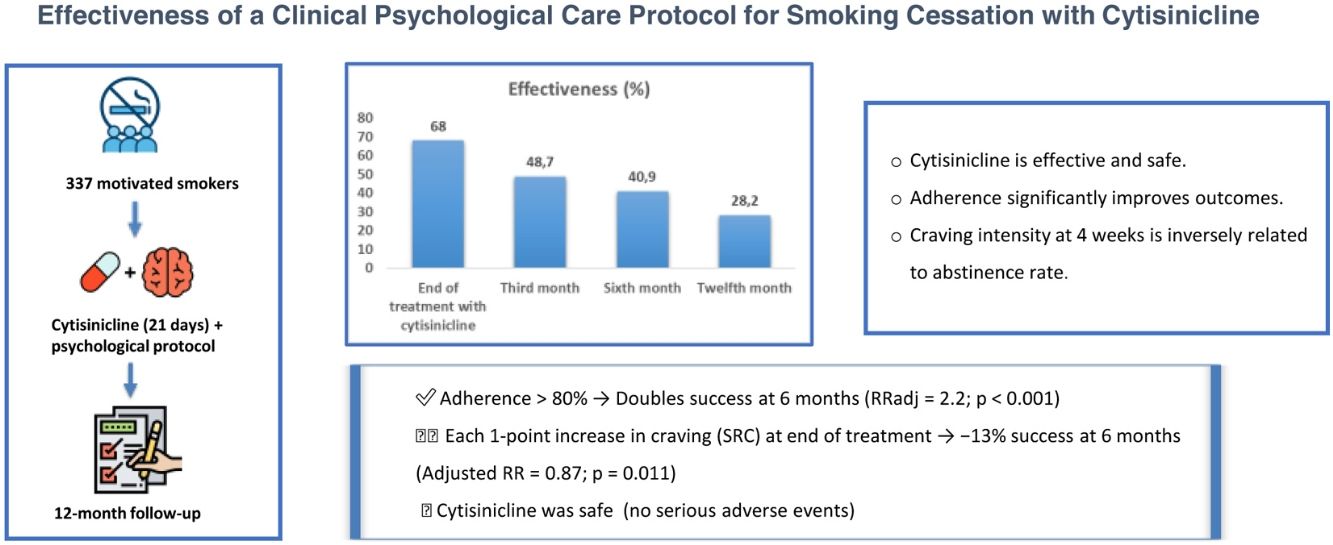
A total of 337 smokers were studied. Effectiveness of cytisinicline was 68% at the end of treatment, but was reduced to 48.7%, 40.9% and 28.2%, at 3rd, 6th and 12th month of follow up respectively. The measurement of adherence and the intensity of craving by SRC showed statistically significant association with effectiveness at 24th week, RRadj=2.2 (p<0.001) and RRadj=0.87 (p=0.011) respectively. Common adverse effects (occurring in more than 10% of patients) were: sleep disorders, headaches, dizziness and digestive disorders.

Conclusions

The effectiveness of protocol was 68% at the end of treatment, but was reduced to 48.7%, 40.9% and 28.2% at 3rd, 6th and 12th months respectively. Subjects who met more than 80% of treatment adherence doubled their chances of success at 6th month. For each point of craving intensity, measured by the SRC, at the end of the pharmacological treatment the chances of success at 6th month were reduced by 13%. Cytisinicline was safe.

Keywords:
Smoking cessation
Cytisinicline
Effectiveness
Adverse effects
Clinical psycological care protocol
Graphical abstract

Article

These are the options to access the full texts of the publication Archivos de Bronconeumología
Member
If you are a member of SEPAR:
  • Go to >>>SEPAR<<< website and sign in.
Subscriber
Subscriber

If you already have your login data, please click here .

If you have forgotten your password you can you can recover it by clicking here and selecting the option “I have forgotten my password”
Purchase
Purchase article

Purchasing article the PDF version will be downloaded

Purchase now
Contact
Phone for subscriptions and reporting of errors
From Monday to Friday from 9 a.m. to 6 p.m. (GMT + 1) except for the months of July and August which will be from 9 a.m. to 3 p.m.
Calls from Spain
932 415 960
Calls from outside Spain
+34 932 415 960
Email
References
[1]
World Health Organization. World No Tobacco Day [Internet]. Available from: https://www.who.int/es/campaigns/world-no-tobacco-day/2024 [accessed 28.12.24].
[2]
Clinical practice guideline treating tobacco use and dependence 2008 update Panel L and S. A clinical practice guideline for treating tobacco use and dependence: 2008 update. A U.S. Public Health Service report.
Am J Prev Med, 35 (2008), pp. 158-176
[3]
C. Rábade-Castedo, J.I. de Granda-Orive, J.A. Riesco-Miranda, E. De Higes-Martínez, Á. Ramos-Pinedo, E. Cabrera-César, et al.
Clinical Practice Guideline of Spanish Society of Pneumology and Thoracic Surgery (SEPAR) on pharmacological treatment of tobacco dependence 2023.
Arch Bronconeumol, 59 (2023), pp. 651-661
[4]
P. Tutka, D. Vinnikov, R.J. Courtney, N.L. Benowitz.
Cytisine for nicotine addiction treatment: a review of pharmacology, therapeutics and an update of clinical trial evidence for smoking cessation.
Addiction (Abingdon, Engl), 114 (2019), pp. 1951-1969
[5]
P. Tutka, W. Zatoński.
Cytisine for the treatment of nicotine addiction: from a molecule to therapeutic efficacy.
Pharmacol Rep, 58 (2006), pp. 777-798
[6]
J. Livingstone-Banks, T.R. Fanshawe, K.H. Thomas, A. Theodoulou, A. Hajizadeh, L. Hartman, et al.
Nicotine receptor partial agonists for smoking cessation.
Cochrane Database Syst Rev, 5 (2023),
[7]
N.A. Rigotti, N.L. Benowitz, J. Prochaska, S. Leischow, M. Nides, B. Blumenstein, et al.
Cytisinicline for smoking cessation.
[8]
C. Puljević, D. Stjepanović, I. Meciar, H. Kang, G. Chan, K. Morphett, et al.
Systematic review and meta-analyses of cytisine to support tobacco cessation.
Addiction, 119 (2024), pp. 1713-1725
[9]
S. Ofori, C. Lu, O.O. Olasupo, B.B. Dennis, N. Fairbairn, P.J. Devereaux, et al.
Cytisine for smoking cessation: a systematic review and meta-analysis.
[10]
J. Foulds, S.I. Allen, J. Yingst.
Cytisinicline to speed smoking cessation in the United States.
JAMA, 330 (2023), pp. 129-130
[11]
N. Lindson, A. Theodoulou, J.M. Ordóñez-Mena, T.R. Fanshawe, A.J. Sutton, J. Livingstone-Banks, et al.
Pharmacological and electronic cigarette interventions for smoking cessation in adults: component network meta-analyses.
Cochrane Database Syst Rev, 9 (2023),
[12]
Evidence review Q for cytisinicline for smoking cessation: Tobacco: preventing uptake, promoting quitting and treating dependence (update): Evidence review Q.
National Institute for Health and Care Excellence (NICE), (2025),
[13]
C.A. Jiménez-Ruiz, R. de Simón Gutiérrez, J. Signes-Costa Miñana, J. Sellarés Torres, J.L. Díaz-Muñoz Maroto, J.A. Riesco Miranda, et al.
Protocolo asistencial clínico-psicológico para el tratamiento del Tabaquismo.
Prevencion de Tabaquismo, 24 (2021), pp. 139-145
[14]
C.A. Jiménez-Ruiz, J.A. Riesco Miranda, A. Martínez Picó, R. de Simón Gutiérrez, J. Signes-Costa Miñana, J.L. Díaz Maroto Muñoz, et al.
The DESTINA study: an observational cross-sectional study to evaluate patient satisfaction and tolerability of cytisine for smoking cessation in Spain.
Arch Bronconeumol, 59 (2023), pp. 270-272
[15]
Spanish Agency of Medicines and Medical Devices. Patient information leaflet: Cytisinicline [Internet]. Madrid: AEMPS. Available from: https://cima.aemps.es/cima/dochtml/p/88873/P_88873.html [accessed 26.2.25].
[16]
A. Ramos Pinedo, E. Prieto Gómez.
Estudio clínico del fumador.
Tratado de Tabaquismo,
[17]
T.F. Heatherton, L.T. Kozlowski, R.C. Frecker, K. Fagerström.
The Fagerström Test for nicotine dependence: a revision of the fagerstrom tolerance questionnaire.
[18]
N. Mushtaq, L.A. Beebe.
Psychometric properties of Fagerström Test for Nicotine Dependence for Smokeless Tobacco Users (FTND-ST).
Nicotine Tob Res, 19 (2017), pp. 1095-1101
[19]
J.I. de Granda-Orive, J.F. Pascual-Lledó, S. Asensio-Sánchez, S. Solano-Reina, M. García-Rueda, Martínez-Muñiz MÁ, et al.
Is there an association between the degree of nicotine dependence and the motivation to stop smoking?.
Arch Bronconeumol, 55 (2019), pp. 139-145
[20]
T.T.U.R. Center, T.D.P. Workgroup, T. Baker, M. Piper, D. McCarthy, D. Bolt, et al.
Time to first cigarette in the morning as an index of ability to quit smoking: implications for nicotine dependence.
Nicotine Tob Res, 9 (2007), pp. S555-S570
[21]
O. Pomerleau, J. Tate, C. Pomerleau, K.O. Fagerström, J. Marks.
Development and validation of a self-rating scale for positive- and negative-reinforcement smoking: the Michigan Nicotine Reinforcement Questionnaire.
Nicotine Tob Res, 5 (2003), pp. 711-718
[22]
S. Shiffman, R. West, D. Gilbert, SRNT Work Group on the Assessment of Craving and Withdrawal in Clinical Trials.
Recommendation for the assessment of tobacco craving and withdrawal in smoking cessation trials.
Nicotine Tob Res, 6 (2004), pp. 599-614
[23]
R. West, M. Ussher, M. Evans, M. Rashid.
Assessing DSM-IV nicotine withdrawal symptoms: a comparison and evaluation of five different scales.
Psychopharmacology (Berl), 184 (2006), pp. 619-627
[24]
K.A. Perkins, J.L. Karelitz, N.C. Jao.
Optimal carbon monoxide criteria to confirm 24-h smoking abstinence.
Nicotine Tob Res, 15 (2013), pp. 978-982
[25]
R. West, P. Hajek, L. Stead, J. Stapleton.
Outcome criteria in smoking cessation trials: proposal for a common standard.
[26]
K. Cahill, S. Stevens, R. Perera, T. Lancaster.
Pharmacological interventions for smoking cessation: an overview and network meta-analysis.
Cochrane Database Syst Rev, 2013 (2013),
[27]
D.E. Jorenby, J.T. Hays, N.A. Rigotti, S. Azoulay, E.J. Watsky, K.E. Williams, et al.
Efficacy of varenicline, an alpha4beta2 nicotinic acetylcholine receptor partial agonist vs placebo or sustained-release bupropion for smoking cessation: a randomized controlled trial.
[28]
A. Clarke, K.L. Price, S. Lummis.
Cytisine's lower potency at 5-HT3 receptors may explain its lower incidence of nausea and vomiting than varenicline.
Presented at: Society for Research on Nicotine and Tobacco,
[29]
J. Hartmann-Boyce, A. Theodoulou, A. Farley, P. Hajek, D. Lycett, L.L. Jones, et al.
Interventions for preventing weight gain after smoking cessation.
Cochrane Database Syst Rev, 2021 (2021),
[30]
J.I. de Granda-Orive, J.F. Pascual-Lledó, S. Asensio-Sánchez, S. Solano-Reina, M. García-Rueda, M.Á. Martínez-Muñiz, et al.
Is the motivation to quit smoking a predictor of abstinence maintenance?.
Tob Prev Cessat, 7 (2021), pp. 1-13
Archivos de Bronconeumología
Article options
Tools
Supplemental materials