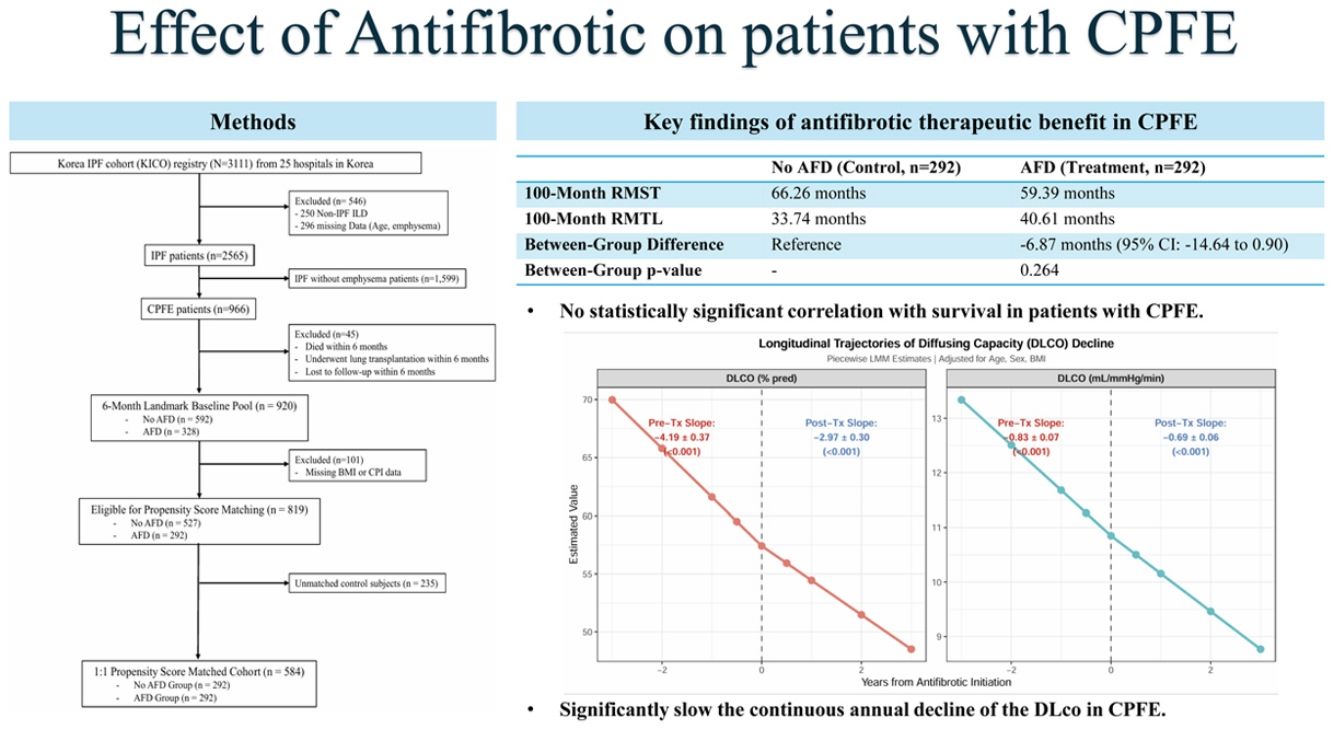

While efficacy of antifibrotics (pirfenidone and nintedanib) in idiopathic pulmonary fibrosis (IPF) is well established, its effects on combined pulmonary fibrosis and emphysema (CPFE) remain unclear. We evaluated the therapeutic efficacy of antifibrotics in CPFE patients.
MethodsThis multicentre study used the Korean IPF Cohort registry, identifying 966 CPFE patients. A 6-month landmark window controlled for immortal time bias. Propensity score matching (PSM) balanced baseline characteristics for age, sex, body mass index (BMI), lung cancer, and Composite Physiologic Index (CPI). Post-matching survival outcomes (N=584) were evaluated via 100-month truncated Restricted Mean Survival Time (RMST) to account for proportional hazards violation. Annual longitudinal lung function trajectories (n=310) were estimated via piecewise linear mixed models (LMM) handling missing data as missing at random.
ResultsIn the matched cohort, conventional Cox analysis exhibited a marginally significant risk in the treatment arm (HR=1.29; 95% CI: 1.01–1.65; p=0.045); however, a distinct trajectory cross-over occurred at ∼100 months. Truncated RMST confirmed that the net survival difference was statistically equivalent (−6.87 months; 95% CI: −14.64 to 0.90; p=0.264). Conversely, a significant physiological benefit was demonstrated in continuous lung function preservation, markedly attenuating the annual rate of diffusing capacity of the lung for carbon monoxide (DLCO) % predicted decline from −4.19±0.37%/year pre-treatment to −2.97±0.30%/year post-treatment (p<0.001).
ConclusionsAlthough antifibrotic therapy does not demonstrate a long-term average survival advantage over a decade, it significantly attenuates the longitudinal physiological decline of lung function (DLCO) in patients with CPFE, providing a protective brake against disease progression.

Combined pulmonary fibrosis and emphysema (CPFE) is a syndrome consisting of two distinct disease entities: fibrosis predominantly in the lower zones and emphysema in the upper zones [1–3]. Although CPFE includes idiopathic pulmonary fibrosis (IPF) and emphysema, it is considered a separate disease entity with distinct clinical and functional characteristics and different prognoses [3]. CPFE is prevalent in males (mean age, 65 years) with a history of significant tobacco exposure (≥40 pack-years) [4]. It is characterized by progressive worsening of respiratory symptoms with high mortality [1,5]. CPFE is more closely related to lung cancer and pulmonary hypertension (PH) than IPF alone [2,3,6,7]. Pulmonary function tests (PFTs) in CPFE reveal preserved lung volumes but a severe reduction in the diffusing capacity of the lung for carbon monoxide (DLCO) [8]. Moreover, the annual decline rates in DLCO and forced vital capacity (FVC) were significantly lower in the CPFE group [9].
Several large, prospective, randomized controlled trials of anti-fibrotic agents have been conducted in patients with IPF [10–14]. Pirfenidone, an oral anti-fibrotic agent for IPF, has demonstrated efficacy in attenuating the decline in FVC and improving survival in these patients [10]. However, despite a CPFE prevalence of up to 30% [5], the efficacy of anti-fibrotic therapy, including pirfenidone, remains unknown in this population. This knowledge gap exists because milestone studies on anti-fibrotic agents excluded patients with a forced expiratory volume in 1 second (FEV1)/FVC ratio below 0.8, a history of chronic obstructive pulmonary disease (COPD), or a predominance of emphysema over fibrotic changes on high-resolution computed tomography (HRCT) scans, thereby excluding CPFE patients [10–13].
Therefore, we aimed to determine whether antifibrotic therapy improves survival and slows disease progression in patients with CPFE by assessing lung function preservation, similar to its established effects in IPF.
MethodsStudy design and populationThis is a multicentre retrospective cohort study used data from Korean IPF Cohort (KICO), which includes newly diagnosed IPF patients aged ≥30 years from 25 universities and teaching hospitals between 2015.7 and 2025.9. The KICO was assembled in June 2016 by the Korean interstitial lung disease (ILD) study group, operating under the Korean Academy of Tuberculosis and Respiratory Diseases. Patients enrolled in the IPF registry in 2008 [15] were also included in this study. This study was approved by the Institutional Review Board of the Severance Hospital (approval number: 4-2019-0031).
The database underwent rigorous IPF diagnostic verification by a multidisciplinary team of pulmonologists, radiologists, and pathologists, who specialize in ILD, following the criteria outlined in the 2018 Official American Thoracic Society/European Respiratory Society/Japanese Respiratory Society/Latin American Thoracic Association Clinical Practice Guideline [16]. Medical records including demographic and clinical characteristics at diagnosis (age, sex, smoking status, family history of ILD, and body mass index [BMI], medical history, PFT results, radiologic patterns, Gender-Age-Physiology [GAP] index, lung cancer history, and survival) were retrospectively reviewed and meticulously documented in a web-based registry (http://www.ipf.crf.kr). For previously diagnosed patients before enrolment, baseline characteristics at initial diagnosis were reviewed. Subsequently, each case underwent a secondary review by the central committee.
DefinitionThe GAP index was calculated using the method suggested in previous literature [17]. Composite Physiologic Index (CPI) was calculated based on previous literatures [18,19].
HRCT findings about emphysema at diagnosis affecting more than 5% of the total lung volume were recorded as positive. CPFE was defined as presence of emphysema in more than 5% of lung on initial chest CT scans, directly adopted from the recently proposed official research definition of CPFE [2]. All other patients were classified as having IPF without emphysema.
In the Republic of Korea, pirfenidone has been designated as the standard therapeutic regimen for patients who conform to the reimbursement criteria established by the National Health Insurance Service as of October 2015. As a result, certain IPF patients diagnosed before this date, or those who did not satisfy these criteria at diagnosis, commenced pirfenidone treatment only after fulfilling the reimbursement criteria, rather than at the point of diagnosis. Consequently, there was a variable interval between the diagnosis of IPF and the initiation of pirfenidone treatment.
In South Korea, nintedanib is officially approved by the Ministry of Food and Drug Safety for the treatment of IPF, it remains strictly non-reimbursed under the National Health Insurance system for a second-line therapy for IPF patients who cannot tolerate pirfenidone due to adverse events, policy consensus has not yet been achieved.
Therefore, to facilitate a robust comparison of pulmonary function before and after the initiation of antifibrotics (either pirfenidone or nintedanib), the PFTs were adjusted to align with the commencement date of antifibrotics administration. All longitudinal data points were aligned symmetrically around the initiation date (time origin). Baseline values were captured within ≤90 days of initiation, and subsequent follow-up windows were sequentially categorized into mutually exclusive intervals: 6 months (>90 to ≤270 days), 12 months (>270 to ≤450 days), 24 months (>541 to ≤900 days), and 36 months (>901 to ≤1260 days), with redundant boundary data strictly excluded. Intermediary 15-to-18-month data (>450 to ≤540 days) were adaptively allocated based on proximity. The finalized evaluation spectrum encompassed sequential validation nodes at −3, −2, −1, −0.5, 0 (baseline), 0.5, 1, 2, and 3 years, mathematically incorporating distinct time-variant vectors representing pre- and post-treatment slopes.
Statistical analysisBaseline characteristics and propensity score matching (PSM)To evaluate baseline demographic and physiological imbalances within the 6-month landmark cohort before and after PSM, statistical significance thresholds were rigorously calculated across all comparative axes. For continuous parameters, inter-group statistical comparisons were executed utilizing the non-parametric Kruskal–Wallis test to robustly account for skewed distributions and standard variance heterogeneities. For categorical indicators, cross-tabulated proportions were evaluated utilizing the Pearson Chi-square test, or Fisher's exact test when the expected cell counts fell below five, ensuring statistical validity for sparse clinical cell distributions.
To evaluate the clinical impact of antifibrotic therapy on transplant-free survival while minimizing selection bias and confounding, a rigorous PSM protocol was implemented. Prior to calculating matching scores, a 6-month landmark window was established to eliminate potential immortal time bias; only patients who survived and were followed for at least 6 months after diagnosis were included in the baseline matching pool. Group assignment was finalized based on landmark criteria, defining the treatment group (AFD) strictly as patients who initiated antifibrotic therapy within 182.5 days (6 months) from diagnosis, whereas the remaining individuals were allocated to the control group (No AFD).
Propensity scores were computed using a logistic regression model incorporating five critical clinical baseline covariates: age at diagnosis, sex, BMI, history of lung cancer, and CPI. 1:1 nearest-neighbor matching without replacement was performed using a stringent caliper width of 0.1 standard deviations of the logit of the propensity score, successfully achieving a robust demographic and physiological equilibrium between the two comparative cohorts.
Cumulative survival and truncated fixed-point estimationTransplant-free survival curves for both pre-matched and post-matched cohorts were generated using the Kaplan–Meier method. For the landmark analysis, the time origin was explicitly defined as the 6-month landmark point, and follow-up months were adjusted accordingly. Clinical events were defined as all-cause mortality or the necessity of lung transplantation.
To provide tangible clinical insights, precise landmark survival rates alongside their corresponding 95% confidence intervals (CIs) were cross evaluated at specific fixed chronological milestones, namely at 1, 3, 5, and 10 years following initial diagnosis.
Restricted mean survival time (RMST) analysisTo rigorously evaluate long-term transplant-free survival trajectories, the validity of the proportional hazards assumption was systematically evaluated utilizing the Schoenfeld residuals test and visual inspection of log-log survival plots. In clinical settings where cumulative survival curves exhibit late-phase intersections or time-varying hazard ratios, conventional log-rank tests and constant Cox proportional hazards models can overemphasize intermediate survival gaps and introduce substantial estimation bias. To statistically accommodate potential proportional hazards violations and provide a less biased, stable association estimate, a RMST analysis was designated as a primary analytical strategy.
The RMST, which quantifies the area under the Kaplan–Meier survival curve up to a specific chronological truncation horizon (τ), explicitly reflects the exact average survival months expected for a patient within that defined clinical evaluation window. To ensure statistical reliability and avoid numerical volatility driven by the sparse number of patients at risk in the ultra-late tracking phase, the maximum temporal truncation horizon (τ) was restricted to a predefined conservative endpoint where active clinical follow-up remained robust. Between-group contrasts were quantified as the absolute difference in RMST, alongside its corresponding 95% confidence intervals and p-values, representing the net average survival months gained or lost.
Longitudinal assessment of lung function decline via piecewise linear mixed models (LMM)To examine pre- and post-treatment physiologic shifts from the true therapeutic index date, piecewise LMM with random intercepts and slopes were targeting the AFD group (n=310). To minimize attrition bias in long-term retrospective data, missing PFT observations were handled under the missing at random framework, maximizing statistical power without patient exclusion [20].
The explicit temporal data availability matrix is summarized in (Supplementary Table 1).
Consequently, this model estimated the adjusted annual rates of decline in FVC and DLCO parameters spanning three years before and after therapy, fully controlling for core confounders including age, sex, and BMI.
All statistical analyses were performed using R software (version 2026.05.1). Differences with a p-value<0.05 were considered statistically significant in all cases.
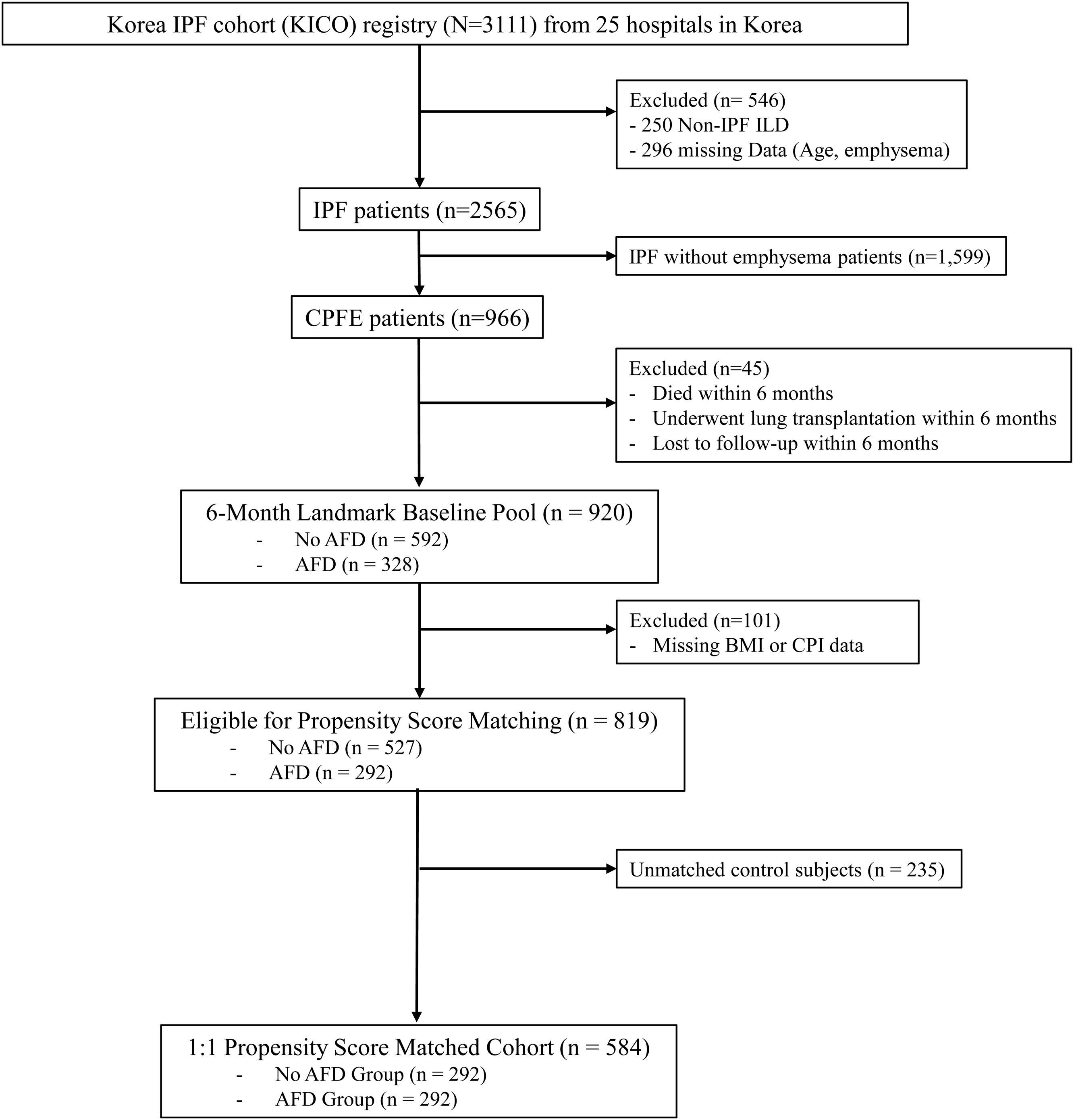
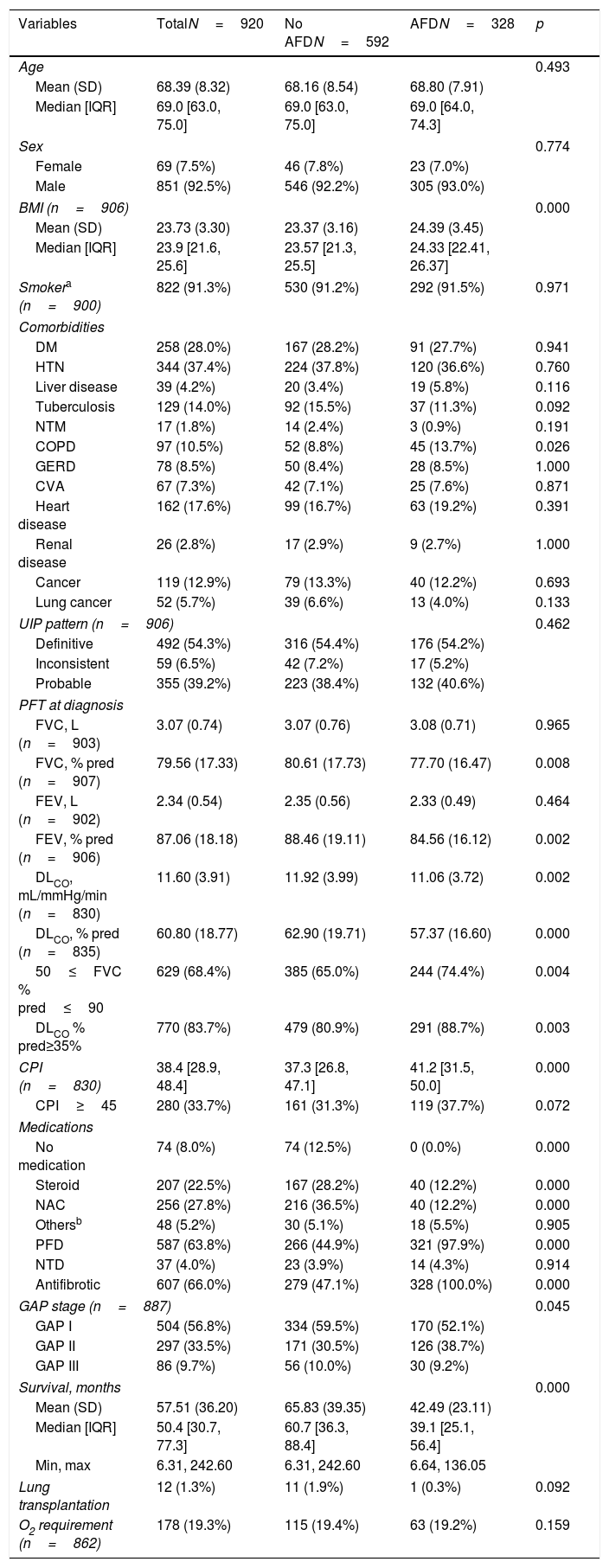
ResultsStudy population and covariate balanceAmong the 3111 patients registered in the KICO registry, 2565 were diagnosed with IPF. After excluding 1599 IPF patients without emphysema, a total of 966 patients with CPFE were initially identified. To control for immortal time bias, a 6-month landmark window was applied, which excluded 46 patients who died, underwent lung transplantation, or were lost to follow-up within 6 months of diagnosis. Prior to PSM, substantial demographic and clinical heterogeneities were observed between the two comparative arms within the 6-month landmark cohort (N=920). The baseline characteristics are described in Table 1. After further excluding 101 patients due to missing baseline BMI or CPI data, 819 eligible patients (509 in the No AFD group and 310 in the AFD group) entered the propensity score matching pool (Fig. 1).
Baseline characteristics of 6-month landmark baseline pool (N=920).
| Variables | TotalN=920 | No AFDN=592 | AFDN=328 | p |
|---|---|---|---|---|
| Age | 0.493 | |||
| Mean (SD) | 68.39 (8.32) | 68.16 (8.54) | 68.80 (7.91) | |
| Median [IQR] | 69.0 [63.0, 75.0] | 69.0 [63.0, 75.0] | 69.0 [64.0, 74.3] | |
| Sex | 0.774 | |||
| Female | 69 (7.5%) | 46 (7.8%) | 23 (7.0%) | |
| Male | 851 (92.5%) | 546 (92.2%) | 305 (93.0%) | |
| BMI (n=906) | 0.000 | |||
| Mean (SD) | 23.73 (3.30) | 23.37 (3.16) | 24.39 (3.45) | |
| Median [IQR] | 23.9 [21.6, 25.6] | 23.57 [21.3, 25.5] | 24.33 [22.41, 26.37] | |
| Smokera (n=900) | 822 (91.3%) | 530 (91.2%) | 292 (91.5%) | 0.971 |
| Comorbidities | ||||
| DM | 258 (28.0%) | 167 (28.2%) | 91 (27.7%) | 0.941 |
| HTN | 344 (37.4%) | 224 (37.8%) | 120 (36.6%) | 0.760 |
| Liver disease | 39 (4.2%) | 20 (3.4%) | 19 (5.8%) | 0.116 |
| Tuberculosis | 129 (14.0%) | 92 (15.5%) | 37 (11.3%) | 0.092 |
| NTM | 17 (1.8%) | 14 (2.4%) | 3 (0.9%) | 0.191 |
| COPD | 97 (10.5%) | 52 (8.8%) | 45 (13.7%) | 0.026 |
| GERD | 78 (8.5%) | 50 (8.4%) | 28 (8.5%) | 1.000 |
| CVA | 67 (7.3%) | 42 (7.1%) | 25 (7.6%) | 0.871 |
| Heart disease | 162 (17.6%) | 99 (16.7%) | 63 (19.2%) | 0.391 |
| Renal disease | 26 (2.8%) | 17 (2.9%) | 9 (2.7%) | 1.000 |
| Cancer | 119 (12.9%) | 79 (13.3%) | 40 (12.2%) | 0.693 |
| Lung cancer | 52 (5.7%) | 39 (6.6%) | 13 (4.0%) | 0.133 |
| UIP pattern (n=906) | 0.462 | |||
| Definitive | 492 (54.3%) | 316 (54.4%) | 176 (54.2%) | |
| Inconsistent | 59 (6.5%) | 42 (7.2%) | 17 (5.2%) | |
| Probable | 355 (39.2%) | 223 (38.4%) | 132 (40.6%) | |
| PFT at diagnosis | ||||
| FVC, L (n=903) | 3.07 (0.74) | 3.07 (0.76) | 3.08 (0.71) | 0.965 |
| FVC, % pred (n=907) | 79.56 (17.33) | 80.61 (17.73) | 77.70 (16.47) | 0.008 |
| FEV, L (n=902) | 2.34 (0.54) | 2.35 (0.56) | 2.33 (0.49) | 0.464 |
| FEV, % pred (n=906) | 87.06 (18.18) | 88.46 (19.11) | 84.56 (16.12) | 0.002 |
| DLCO, mL/mmHg/min (n=830) | 11.60 (3.91) | 11.92 (3.99) | 11.06 (3.72) | 0.002 |
| DLCO, % pred (n=835) | 60.80 (18.77) | 62.90 (19.71) | 57.37 (16.60) | 0.000 |
| 50≤FVC % pred≤90 | 629 (68.4%) | 385 (65.0%) | 244 (74.4%) | 0.004 |
| DLCO % pred≥35% | 770 (83.7%) | 479 (80.9%) | 291 (88.7%) | 0.003 |
| CPI (n=830) | 38.4 [28.9, 48.4] | 37.3 [26.8, 47.1] | 41.2 [31.5, 50.0] | 0.000 |
| CPI≥45 | 280 (33.7%) | 161 (31.3%) | 119 (37.7%) | 0.072 |
| Medications | ||||
| No medication | 74 (8.0%) | 74 (12.5%) | 0 (0.0%) | 0.000 |
| Steroid | 207 (22.5%) | 167 (28.2%) | 40 (12.2%) | 0.000 |
| NAC | 256 (27.8%) | 216 (36.5%) | 40 (12.2%) | 0.000 |
| Othersb | 48 (5.2%) | 30 (5.1%) | 18 (5.5%) | 0.905 |
| PFD | 587 (63.8%) | 266 (44.9%) | 321 (97.9%) | 0.000 |
| NTD | 37 (4.0%) | 23 (3.9%) | 14 (4.3%) | 0.914 |
| Antifibrotic | 607 (66.0%) | 279 (47.1%) | 328 (100.0%) | 0.000 |
| GAP stage (n=887) | 0.045 | |||
| GAP I | 504 (56.8%) | 334 (59.5%) | 170 (52.1%) | |
| GAP II | 297 (33.5%) | 171 (30.5%) | 126 (38.7%) | |
| GAP III | 86 (9.7%) | 56 (10.0%) | 30 (9.2%) | |
| Survival, months | 0.000 | |||
| Mean (SD) | 57.51 (36.20) | 65.83 (39.35) | 42.49 (23.11) | |
| Median [IQR] | 50.4 [30.7, 77.3] | 60.7 [36.3, 88.4] | 39.1 [25.1, 56.4] | |
| Min, max | 6.31, 242.60 | 6.31, 242.60 | 6.64, 136.05 | |
| Lung transplantation | 12 (1.3%) | 11 (1.9%) | 1 (0.3%) | 0.092 |
| O2 requirement (n=862) | 178 (19.3%) | 115 (19.4%) | 63 (19.2%) | 0.159 |
CPFE, combined pulmonary fibrosis and emphysema; BMI, body mass index (kg/m2); COPD, chronic obstructive pulmonary disease; CT, computed tomography; UIP, usual interstitial pneumonia; PFT, pulmonary function tests; CPI, composite physiologic index=91.0−(0.65×percent predicted diffusing capacity for carbon monoxide [DLCO])−(0.53×percent predicted forced vital capacity [FVC])+(0.34×percent predicted forced expiratory volume in one second [FEV1]); % pred, percent predicted; GAP, gender-age-physiology index; PFD, Pirfenidone.
Other immunosuppressants such as azathioprine, mycophenolate mofetil.
All continuous variables were analyzed using the Student's t-test or the Kruskal–Wallis test and expressed as mean±standard deviation (SD) or median [interquartile range, IQR]. Categorical variables were analyzed using the Chi-square and Fisher's exact tests and expressed as numbers with percentages.

1:1 nearest-neighbor matching using a strict caliper width of 0.1 successfully generated a well-balanced cohort of 584 patients (292 pairs of No AFD and AFD groups) (Supplementary Fig. 1 and Supplementary Table 2). The baseline characteristics of a well-balanced cohort of 584 patients are described in Supplementary Table 3.
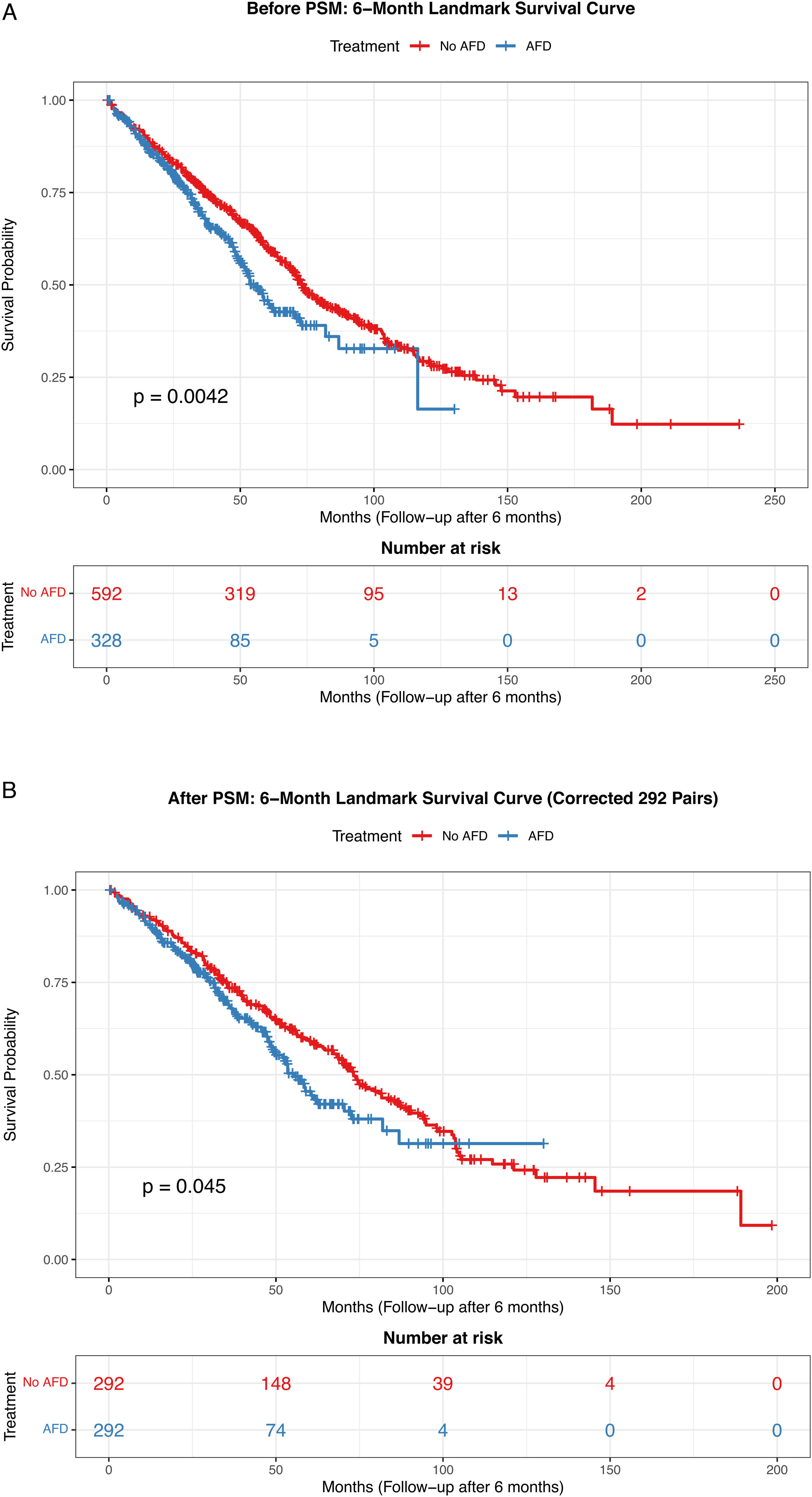
Survival analysisCumulative survival trajectories and landmark Cox estimates (before vs. after PSM)Within the unmatched 6-month landmark cohort (N=920; 592 No AFD vs. 328 AFD), the AFD group displayed a significantly lower survival probability (log-rank p=0.0042; HR=1.36, 95% CI: 1.10–1.67, p=0.004; Fig. 2A). Following 1:1 propensity score matching (N=584), the survival trajectories converged substantially, though the AFD group still maintained a marginally significant risk in both the landmark Kaplan–Meier curves and conventional Cox analysis (log-rank p=0.045; HR=1.29, 95% CI: 1.01–1.65, p=0.045; Fig. 2B).

Kaplan–Meier survival curves for transplant-free survival before and after propensity score matching within the 6-month landmark cohort. (A) Cumulative survival trajectory in the unadjusted pre-matching baseline pool (N=920). The 6-month landmark milestone following initial diagnosis is anchored as the temporal time origin (Months=0). The red line represents the No AFD control group (n=592), and the blue line indicates the AFD treatment group (n=328). Statistical comparison via the conventional log-rank test demonstrates a significantly lower survival probability in the unadjusted AFD arm (p=0.0042), primarily reflecting baseline clinical severity selection biases. (B) Cumulative survival trajectory in the 1:1 propensity score-matched cohort (N=584). Strict 1:1 nearest-neighbor matching successfully equilibrated baseline prognostic confounders, generating 292 balanced pairs (n=292 in the No AFD group and n=292 in the AFD group). The conventional log-rank test demonstrates a marginally significant risk in the matched AFD treatment arm (p=0.045). Notably, a prominent survival intersection (cross-over phenomenon) is captured at approximately 100 months after the landmark time origin, driven by a stable survival plateau in the ultra-late phase of the AFD treatment arm, indicating a fundamental violation of the proportional hazards assumption. The bottom panels across both figures explicitly map the detailed chronological matrix of the number of patients remaining at risk over the long-term observational windows.
However, the matched trajectories revealed a prominent survival cross-over at approximately 100 months, violating the proportional hazards assumption and indicating that the constant Cox risk ratio (HR=1.29) cannot fully characterize time-varying survival. Furthermore, the number of patients at risk in the AFD arm diminished rapidly past 120 months (4 patients at 100 months, 0 at 150 months), introducing late-phase numerical instability. To address this structural violation and provide a less biased, interpretable association estimate, a RMST analysis [21,22] was subsequently executed up to a conservative truncation horizon of 100 months.
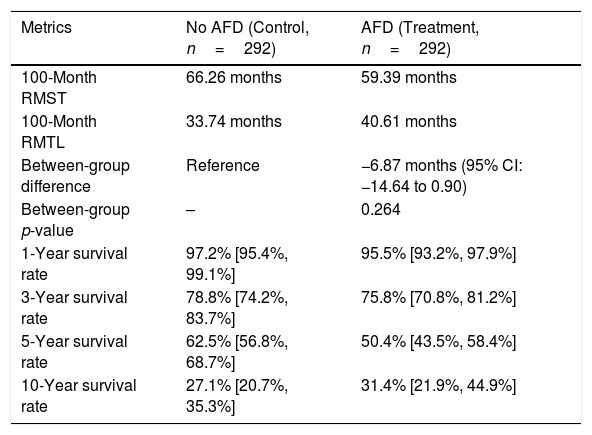
Milestone survival rates and truncated fixed-point RMST estimations after PSMWithin the 1:1 propensity score-matched 6-month landmark cohort (N=584), truncated fixed-point calculations and chronological milestone evaluations demonstrated a dynamic shift in survival profiles over time (Table 2). Within this clinical evaluation horizon, the estimated average survival time was 66.26 months for the No AFD control group and 59.39 months for the AFD treatment group. The estimated restricted mean survival time difference between the two matched arms was −6.87 months (95% CI: −14.64 to 0.90), which was confirmed to be not statistically significant (Between-Group p-value=0.264) (Supplementary Fig. 2).
Restricted mean survival time and chronological milestone survival rates within the 1:1 propensity score-matched 6-month landmark cohort.
| Metrics | No AFD (Control, n=292) | AFD (Treatment, n=292) |
|---|---|---|
| 100-Month RMST | 66.26 months | 59.39 months |
| 100-Month RMTL | 33.74 months | 40.61 months |
| Between-group difference | Reference | −6.87 months (95% CI: −14.64 to 0.90) |
| Between-group p-value | – | 0.264 |
| 1-Year survival rate | 97.2% [95.4%, 99.1%] | 95.5% [93.2%, 97.9%] |
| 3-Year survival rate | 78.8% [74.2%, 83.7%] | 75.8% [70.8%, 81.2%] |
| 5-Year survival rate | 62.5% [56.8%, 68.7%] | 50.4% [43.5%, 58.4%] |
| 10-Year survival rate | 27.1% [20.7%, 35.3%] | 31.4% [21.9%, 44.9%] |
AFD, antifibrotic drug therapy; CI, confidence interval; RMST, restricted mean survival time; RMTL, restricted mean time lost.
The temporal truncation horizon (τ) was set optimally to 100 months based on the empirical survival cross-over point and to prevent numerical volatility in the late-phase log-rank estimations. The 6-month landmark milestone following initial diagnosis was anchored as the baseline time origin (t=0) for all chronological milestone survival evaluations. RMST represents the exact area under the Kaplan–Meier survival curve, corresponding to the expected average survival months gained within the 100-month evaluation window, while RMTL represents the average survival months lost. Between-group differences and p-values were evaluated utilizing the survRM2 library package.
Following these comprehensive area-under-the-curve metrics, sequential milestone evaluations revealed the shifting dynamics of the cumulative trajectories point-by-point. The 1-year and 3-year transplant-free survival rates after diagnosis were comparable between the two matched groups (97.2% [95.4–99.1%] vs. 95.5% [93.2–97.9%] and 78.8% [74.2–83.7%] vs. 75.8% [70.8–81.2%] for the No AFD and AFD groups, respectively). At the 5-year milestone, the No AFD control group exhibited a higher cumulative survival probability (62.5% [56.8–68.7%]) compared to the AFD treatment group (50.4% [43.5–58.4%]). However, a prominent survival reversal occurred in the ultra-late phase; at 10 years post-diagnosis, the survival rate of the AFD treatment arm (31.4% [21.9–44.9%]) substantially outperformed that of the No AFD control arm (27.1% [20.7–35.3%]), consistent with the late-phase cross-over of the cumulative trajectories (Table 2). These integrated findings indicate that while conventional time-fixed hazard models may overemphasize intermediate survival gaps, the net long-term average survival duration remains statistically equivalent between the comparative arms once the baseline demographic and physiological severities are fully equilibrated.
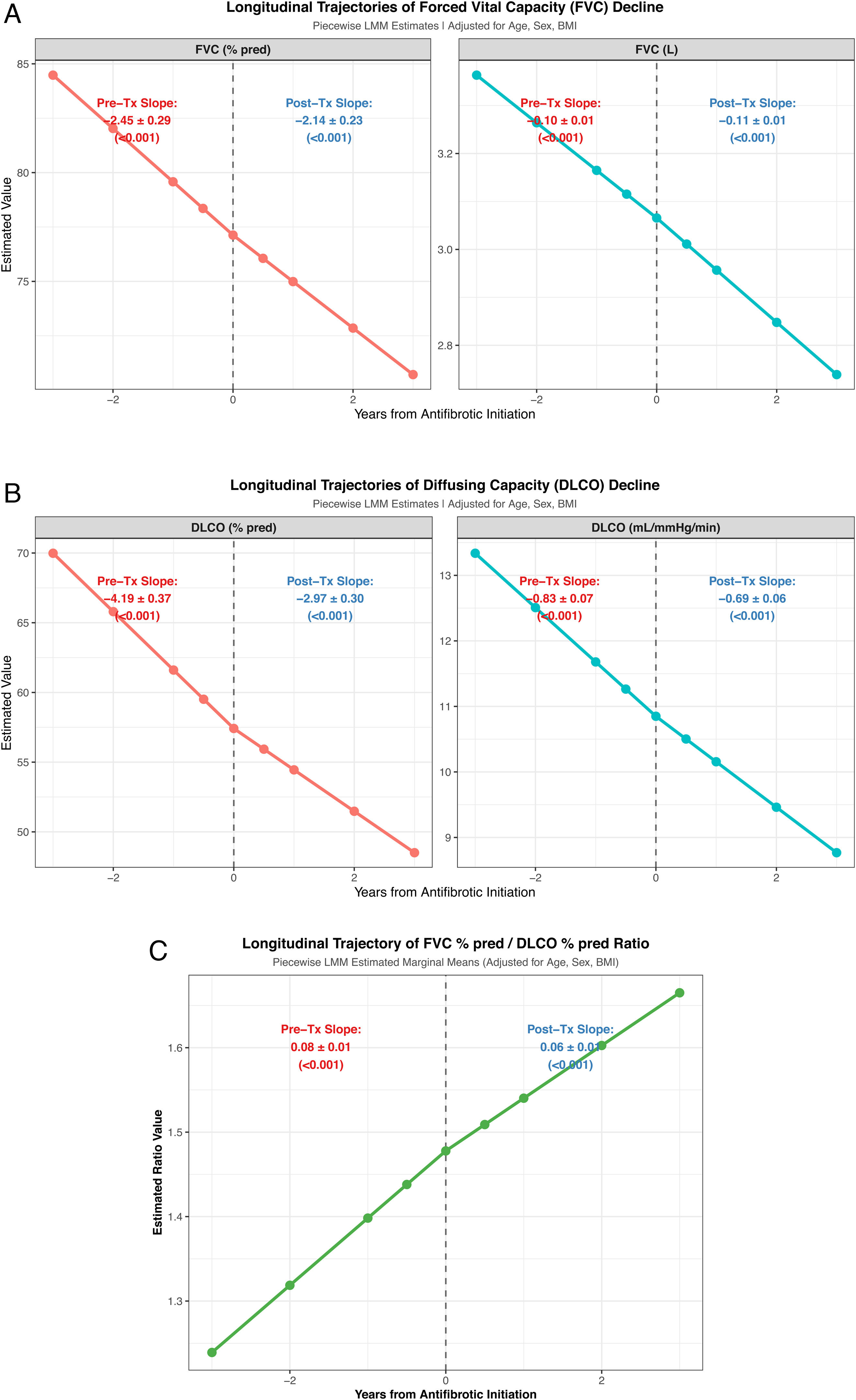
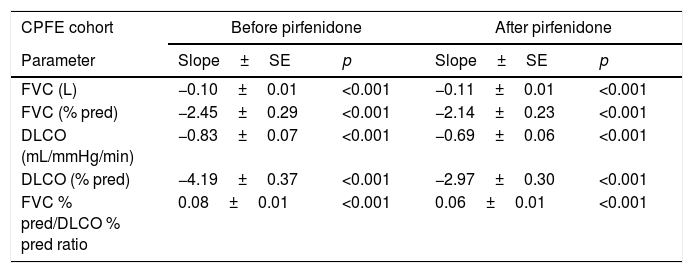
Longitudinal trajectories of lung function decline before and after antifibrotic therapyTo elucidate the continuous therapeutic impact of antifibrotic medication on respiratory physiological attenuation, a piecewise LMM analysis was meticulously evaluated within the 6-month landmark baseline cohort (N=920). Longitudinal functional patterns adjusted for potential baseline co-factors (age, sex, and body mass index) demonstrated pronounced shifts in continuous annualized decline kinetics between the pre-treatment and post-treatment tracking eras (Table 3 and Fig. 3).
Longitudinal annual rates of lung function decline before and after pirfenidone therapy estimated by piecewise linear mixed models (LMM).
| CPFE cohort | Before pirfenidone | After pirfenidone | ||
|---|---|---|---|---|
| Parameter | Slope±SE | p | Slope±SE | p |
| FVC (L) | −0.10±0.01 | <0.001 | −0.11±0.01 | <0.001 |
| FVC (% pred) | −2.45±0.29 | <0.001 | −2.14±0.23 | <0.001 |
| DLCO (mL/mmHg/min) | −0.83±0.07 | <0.001 | −0.69±0.06 | <0.001 |
| DLCO (% pred) | −4.19±0.37 | <0.001 | −2.97±0.30 | <0.001 |
| FVC % pred/DLCO % pred ratio | 0.08±0.01 | <0.001 | 0.06±0.01 | <0.001 |
CPFE, combined pulmonary fibrosis and emphysema; IPF, idiopathic pulmonary fibrosis; FVC, forced vital capacity; DLCO, diffusing capacity of the lung for carbon monoxide; % pred, percent predicted; SE, standard error.
Continuous longitudinal annual trajectories were estimated utilizing piecewise LMM with random intercepts and random slopes grouping by individual patient identification numbers to account for patient-specific physiological variance. The dynamic timeline was structured symmetrically around the exact date of pirfenidone initiation, explicitly anchored as the longitudinal time origin (Year 0). Longitudinal computations spanned multiple repetitive fixed intervals across a 6-year period (from 3 years pre-treatment to 3 years post-treatment) within the landmark baseline cohort (n=310). To obtain unbiased marginal estimates of the continuous annualized slopes, all models were fully adjusted for essential baseline clinical confounders, including age at diagnosis as a continuous covariate, sex as a categorical indicator, and body mass index as a continuous parameter. Missing pulmonary function test data points were handled under the missing at random statistical framework to maximize overall statistical power without introducing systemic patient exclusion bias.

Longitudinal trajectories of lung function decline before and after antifibrotic therapy initiation estimated by piecewise linear mixed models within the landmark baseline cohort. (A) Annualized decline trajectories of forced vital capacity (FVC) split by percent predicted (FVC, % pred; left panel) and absolute volume (FVC, L; right panel). Linear slopes (annual change±standard error) along with their corresponding statistical significance (p-values) are explicitly annotated for the pre-treatment and post-treatment observation windows. (B) Annualized decline trajectories of diffusing capacity of the lung for carbon monoxide (DLCO) split by percent predicted (DLCO, % pred; left panel) and absolute capacity (DLCO, mL/mmHg/min; right panel). Explicit piecewise slope values and p-values demonstrate the prominent post-treatment physiologic stabilization and mitigation of continuous alveolar-capillary gas exchange deterioration. (C) Longitudinal annualized trajectory of the FVC % pred/DLCO % pred ratio. The continuous positive progression vector exhibits a statistically significant mitigation and flattening following antifibrotic initiation, indicating a subtle stabilization of secondary pulmonary vascular involvement and ventilation–perfusion mismatch over time. All longitudinal predictions across panels (A)–(C) are modeled using continuous piecewise linear mixed-effects equations (n=310) fully adjusted for continuous age at diagnosis, biological sex, and body mass index. The vertical dashed line across each pane anchors the exact initiation date of antifibrotic therapy as the temporal time origin (Year=0).
The annualized rate of forced vital capacity percent predicted (FVC, % pred) decline exhibited a visible physiological stabilization following treatment initiation, shifting significantly from a pre-treatment slope of −2.45%/year to a post-treatment slope of −2.14%/year. In contrast, the absolute FVC volumetric trajectory remained constant, showing a slight steepening from −0.10L/year pre-treatment to −0.11L/year post-treatment (p<0.001; Fig. 3A).
Concomitantly, the most prominent physiological stabilization effect was observed in the pulmonary gas exchange reserves. The rapid annual degradation of the DLCO, % pred prior to treatment -4.19%/year was markedly mitigated and flattened to -2.97%/year following antifibrotic initiation, demonstrating a highly substantial deceleration of continuous alveolar capillary injury. Mirroring this structural preservation, the absolute DLCO also achieved significant stabilization, with the pre-treatment slope of −0.83mL/mmHg/min/year flattening to −0.69mL/mmHg/min/year post-treatment (Fig. 3B).
Lastly, the physiological marker tracking the FVC % pred/DLCO % pred ratio, a known surrogate for vascular involvement in CPFE [23], showed a continuous but decelerating positive trajectory, tapering down from a pre-treatment slope of 0.08 units/year to a post-treatment slope of 0.06units/year (Fig. 3C), indicating a subtle stabilization of secondary vascular ventilation–perfusion mismatching over long-term retrospective tracking.
DiscussionOur study evaluated the effectiveness of antifibrotics in patients with CPFE, a group generally excluded from the landmark clinical trial of antifibrotics. There was no significant survival benefit in patients with CPFE prescribed with antifibrotics. There was no significant transplant-free survival benefit in patients with CPFE prescribed with antifibrotics within a 100-month truncation horizon (RMST difference: −6.87 months, p=0.264), which is consistent with previous study among US-Based cohort study [24]. However, a highly significant physiological benefit was achieved in lung function preservation, markedly slowing the continuous annual rate of DLCO decline (from −4.19±0.37%/year pre-treatment to −2.97±0.30%/year post-treatment, p<0.001).
At 5 years post-diagnosis, the No AFD group exhibited a higher transplant-free survival rate than the AFD group (62.5% vs. 50.4%), whereas a distinct survival reversal was achieved at the ultra-late 10-year milestone, with the AFD group outperforming the control group (31.4% vs. 27.1%). This prominent survival crossover may suggest a potential “late catch-up effect,” which could indicate that the cumulative physiological benefit of early antifibrotic exposure gradually unfolds during extended long-term observation by effectively applying a brake to the underlying disease progression. In the ultra-late phase, while the untreated control group experiences a steeper survival decline, the multi-year stabilizing trends in the antifibrotic group might reflect a deceleration of the long-term attrition rate. However, given that the RMST analysis showed no statistically significant survival difference between the groups (p=0.264), this possible trend requires cautious interpretation and warrants further confirmation in prospective, larger-scale studies.
This potential delayed trend might help counterbalance the high-risk baseline phenotype that inherently characterizes this severe CPFE population. Consequently, our findings underscore that intermediate observations may fail to capture the true long-term utility of these agents. Future prospective trials with extended chronological follow-up are highly warranted to definitively determine whether this observed stabilizing trend eventually translates into a statistically significant survival advantage beyond a decade.
Overall, it can be inferred that DLCO could be interpreted as one essential component of a multidimensional assessment for assessing the preservation of lung function with antifibrotics in CPFE and that FVC is inappropriate for monitoring disease progression consistent with findings from previous studies [25]. However, further studies are needed to find other appropriate surrogates for evaluating the effect of antifibrotics on lung function preservation in CPFE because DLCO is largely affected by the patient's condition and intercenter measurement variability [26].
Several limitations of the present study warrant consideration.
First, Pulmonary hypertension (PH), a critical prognostic determinant in CPFE, could not be directly evaluated within our survival analysis framework.
PH is conventionally defined by a mean pulmonary artery pressure (mPAP) greater than 25mmHg via invasive right heart catheterization (RHC). However, due to its invasive nature, RHC is not routinely performed in clinical practice, particularly for patients with IPF; consequently, exact mPAP data could not be acquired in our cohort. To circumvent this clinical barrier, expert consensus guidelines propose an estimated right ventricular systolic pressure (RVSP) greater than 40mmHg via echocardiography as indicative of “suspected PH” [27]. Nevertheless, in this study, valid longitudinal RVSP assessments were available for only 264 patients, rendering the missing data rate too extensive to construct a robust, direct PH-stratified analysis.
To address this limitation, we evaluated alternative validated physiological surrogates. Previous literature has established that longitudinal deteriorations in DLCO and the FVC/DLCO percent predicted ratio possess powerful direct correlations with secondary PH development and progression in chronic lung diseases [23,28–30] Crucially, our piecewise LMM analysis successfully demonstrated a substantial deceleration and flattening in the continuous annual decline kinetics of both gas exchange parameters following early antifibrotic therapy. This physiological stabilization strongly implies that early antifibrotic exposure may exert a protective hemodynamic brake, potentially translating into a positive long-term impact on secondary PH-related prognostic outcomes. Future large-scale randomized controlled trials (RCTs) incorporating standardized, systematic longitudinal assessments of mPAP or comprehensive echocardiographic protocols are highly warranted to definitively validate these continuous hemodynamic preservation trends.
Second, due to its retrospective nonrandomized design, various inherent biases (such as selection bias and immortal bias) and confounding factors are inevitably present. To mitigate immortal time bias, we performed a landmark analysis alongside a time-dependent Cox proportional hazards analysis. We set a predefined landmark time point at 6 months from the index date to ensure that only patients surviving up to this point were evaluated, thereby preventing an artificial overestimation of survival benefits for the treated group. Furthermore, to mathematically control for the varying timing of treatment initiation, antifibrotic use was treated as a time-dependent covariate in the time-dependent Cox proportional hazards analysis. This approach ensures that a patient's person-time is appropriately classified as “untreated” until the actual date of drug initiation and “treated” thereafter, minimizing potential bias in the estimate of the true treatment effect on survival. Nevertheless, despite these rigorous statistical adjustments and the application of propensity score matching, the inherent retrospective and observational nature of this study implies that residual confounding cannot be completely excluded. Unmeasured or unrecorded clinical variables, which could not be accounted for in our models, may still have influenced the survival outcomes.
Third, utilizing a ≥5% emphysema threshold for the research definition of CPFE may introduce certain limitations. As noted in the consensus statement guidelines, an emphysema extent of less than 5% is unlikely to significantly impact patient physiology or clinical outcomes. Furthermore, such a low threshold is inherently more susceptible to interobserver disagreement during visual quantification on HRCT, which could potentially lead to the misclassification of patients. Consequently, this might have contributed to the heterogeneity of our study population. Future studies incorporating stricter clinical criteria (e.g., ≥15% emphysema) or automated quantitative CT software are warranted to validate our findings.
In conclusion, our study provides robust, bias-controlled insights into the long-term therapeutic utility of early antifibrotic therapy in patients with CPFE within a rigorous 6-month landmark milestone network. Although early antifibrotic intervention does not translate into a statistically significant overall survival duration advantage over a decade due to an explicit late-phase survival cross-over, our findings suggest it may help attenuate the continuous, longitudinal physiological decline of lung function, most notably by preserving DLCO. Nevertheless, it must be emphasized that no statistically significant long-term survival benefit was demonstrated after our adjusted analyses. However, we acknowledge that serial changes in DLco can be highly variable and influenced by confounding factors such as pulmonary vasculopathy, hemoglobin fluctuations, and measurement variations. Consequently, we propose that DLco could be utilized as one of the components of a multi-dimensional assessment—integrated alongside longitudinal chest CT findings, exercise tolerance tests, and subjective clinical symptoms—to comprehensively evaluate disease trajectory and therapeutic responses in patients with CPFE in clinical practice. Ultimately, future prospective multi-center randomized controlled trials utilizing standardized direct hemodynamic assessments are highly warranted to definitively validate these long-term survival and preservation trends.
Conference presentationThe findings reported in this manuscript have not been previously presented at any conferences and are not part of a PhD thesis.
Ethics statementThis study was approved by the Institutional Review Board of the Severance Hospital (approval number: 4-2019-0031).
Declaration of generative AI and AI-assisted technologies in the writing processThere is nothing to disclose.
FundingThis research did not receive any specific grant from funding agencies in the public, commercial, or not-for-profit sectors.
Conflict of interestThere were no conflicts of interest.
Data availability statementThe datasets used and/or analyzed during the current study are available from the corresponding author on reasonable request.
The authors thank all members of The Korean ILD Study Group, comprising 25 hospitals, who helped with data collection. They also thank Editage (www.editage.co.kr) for English language editing and the Biostatistics Collaboration Unit, Department of Biomedical Systems Informatics, Yonsei University College of Medicine, for helping with statistical analyses.
The followings are the supplementary data to this article: