Chronic Obstructive Pulmonary Disease (COPD) is a heterogeneous condition whose trajectory varies substantially among individuals. While most patients are diagnosed in their sixth or seventh decade, a clinically important subgroup develops airflow obstruction at a younger age, a phenotype termed early-onset or “young COPD” [1,2]. Understanding what distinguishes these patients is central to improving early detection. Among the molecular pathways implicated in COPD susceptibility, the Hedgehog (HH) signaling cascade governs lung branching morphogenesis, epithelial–mesenchymal homeostasis, injury repair, and has been extensively reviewed as a candidate therapeutic target in COPD [3]. Hedgehog Interacting Protein (HHIP), a secreted physiological inhibitor of Sonic Hedgehog, is consistently identified across genome-wide association studies as a major COPD-risk locus at chromosome 4q31 [4–6]. In animal models, Hhip haploinsufficiency produces spontaneous age-related emphysema and aggravates cigarette-smoke-induced lung damage [7,8]. Yet only a few studies have quantified circulating HHIP protein in COPD patients, and none has examined its continuous relationship with age of disease onset [9]. Current terminology distinguishes chronologically defined “young COPD” from “early COPD”, which refers to biologically early disease [1,2]. For “young COPD”, the Global Initiative for Chronic Obstructive Lung Disease (GOLD)-endorsed threshold of 50 years is most widely used prospectively, while some birth cohorts have instead reported outcomes at a fixed follow-up age of 53 years. The present study addresses the timing of clinical onset rather than either “young” or “early” COPD as defined above. Here, we tested whether serum HHIP levels are associated with the timing of COPD onset in a large, well-phenotyped multicenter cohort.
We studied 380 patients with confirmed COPD (post-bronchodilator FEV1/FVC<0.70) enrolled in the COBRA observational cohort, a national multicenter program sponsored by the French National Institute of Health and Medical Research (INSERM; ethics approval 2008-A00294-51/1). COBRA prospectively follows patients across 12 university hospitals with standardized assessments and linked biobanking. Written informed consent was obtained from all participants. Peripheral venous blood collected at inclusion was immediately frozen at −80°C and transported to a centralized Biological Resources Center. Serum HHIP was measured by sandwich ELISA (E-EL-H0888-96T, Elabscience; sensitivity 0.19ng/mL, range 0.31–20ng/mL); all assays were performed blinded to clinical phenotype. All serum samples were assayed at a uniform 1:10 dilution, so that raw concentrations fell within the calibration range of the kit; reported values are these concentrations multiplied by the dilution factor. The manufacturer reports intra-assay and inter-assay coefficients of variation of <5% and <9%, respectively. Age of COPD onset was taken from the medical record when documented and otherwise estimated as the age at the first COPD-related hospital visit. No consensus threshold applies to a retrospectively documented age of clinical onset, and dichotomizing a continuous variable discards information and reduces statistical power. We therefore treated age of onset as a continuous trait throughout, which also allows any dose-response relationship with circulating HHIP to be assessed. No participant was excluded because of disease severity at the time of diagnosis. The Pearson correlation coefficient quantified the unadjusted linear association between serum HHIP concentration and age of COPD onset. Potential predictors of log-transformed serum HHIP were assessed in univariate log-linear models (age of onset, pack-years, sex, FEV1% predicted, blood eosinophils). Blood eosinophils, expressed as a percentage of leukocytes, were examined because they are currently a widely used biomarker in COPD and directly linked to therapeutic decisions. To assess independence, a multivariate model including age of onset and pack-years was fitted. Analyses were performed with SAS 9.04 and R 4.1.3.
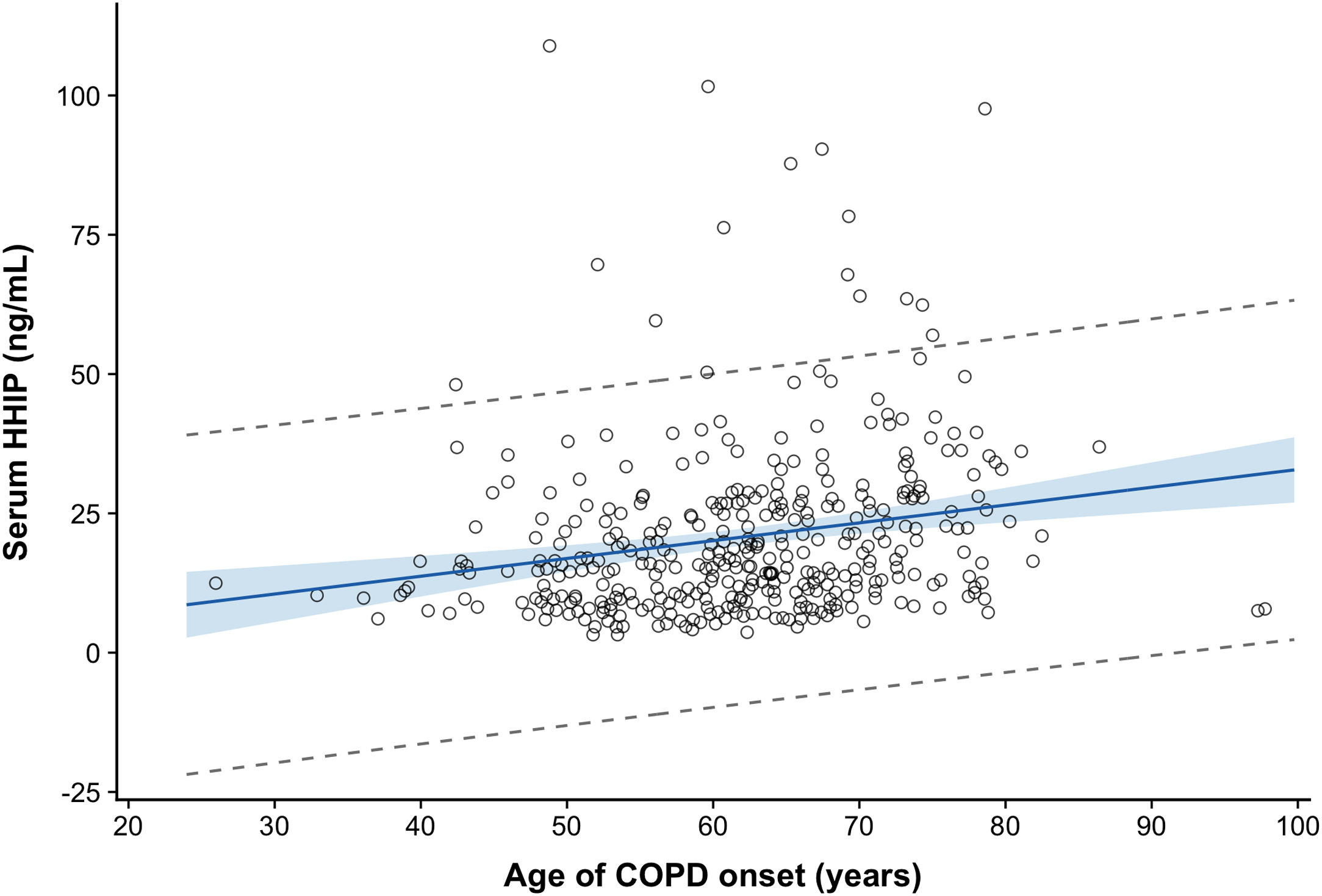
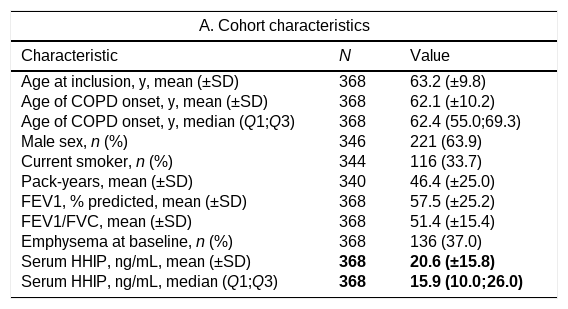
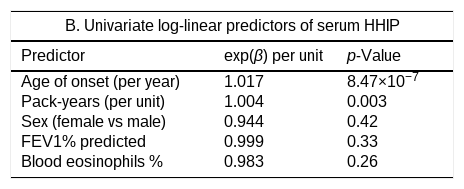
Patient characteristics are summarized in Table 1A, panel A. Sample sizes vary by variable due to missing data (n=340–368). The 12 participants without a documented or estimable age of onset were excluded from onset-related analyses. The cohort was predominantly male (63.9%), with a median predicted FEV1 of 56% and emphysema documented in 37% of patients. The mean age of COPD onset was 62.1±10.2 years (median 62.4; range 25.8–97.6). Mean serum HHIP was 20.6±15.8ng/mL (median 15.9). A continuous positive association was observed between serum HHIP and age of disease onset (Pearson r=0.20, p<0.0001; Fig. 1): for every additional year of onset, HHIP increased by 0.31ng/mL (SE 0.08, p<0.0001). In univariate log-linear models (Table 1B, panel B), age of onset was the strongest predictor of serum HHIP (exp(β)=1.017 per year, p=8.47×10⁻⁷), meaning each additional year of onset was associated with 1.7% higher circulating HHIP. Pack-years were also significant (exp(β)=1.004, p=0.003). Sex, FEV1, and blood eosinophils were not significantly associated with serum HHIP (all p>0.25). In a multivariate model adjusted for pack-years, age of onset remained independently associated with log(HHIP) (exp(β)=1.014, p<0.001), and pack-years retained significance (exp(β)=1.003, p=0.027; adjusted R2=0.06). The unadjusted explained variance of age of onset alone was modest (r2=0.04), consistent with the multifactorial nature of COPD onset.
Patient characteristics.
| A. Cohort characteristics | ||
|---|---|---|
| Characteristic | N | Value |
| Age at inclusion, y, mean (±SD) | 368 | 63.2 (±9.8) |
| Age of COPD onset, y, mean (±SD) | 368 | 62.1 (±10.2) |
| Age of COPD onset, y, median (Q1;Q3) | 368 | 62.4 (55.0;69.3) |
| Male sex, n (%) | 346 | 221 (63.9) |
| Current smoker, n (%) | 344 | 116 (33.7) |
| Pack-years, mean (±SD) | 340 | 46.4 (±25.0) |
| FEV1, % predicted, mean (±SD) | 368 | 57.5 (±25.2) |
| FEV1/FVC, mean (±SD) | 368 | 51.4 (±15.4) |
| Emphysema at baseline, n (%) | 368 | 136 (37.0) |
| Serum HHIP, ng/mL, mean (±SD) | 368 | 20.6 (±15.8) |
| Serum HHIP, ng/mL, median (Q1;Q3) | 368 | 15.9 (10.0;26.0) |
Relationship between serum HHIP protein levels (ng/mL) and age of COPD onset (years). Line: ordinary least-squares regression of untransformed serum HHIP on age of onset, without covariate adjustment (slope 0.31ng/mL per year, SE 0.08; Pearson r=0.20, p<0.0001; n=368). Shaded area: 95% confidence band of the fitted line; dashed: 95% prediction interval. Adjusted analyses are reported in Table 1B and in the text. HHIP: Hedgehog Interacting Protein.
Univariate predictors of log-transformed serum HHIP.
| B. Univariate log-linear predictors of serum HHIP | ||
|---|---|---|
| Predictor | exp(β) per unit | p-Value |
| Age of onset (per year) | 1.017 | 8.47×10⁻⁷ |
| Pack-years (per unit) | 1.004 | 0.003 |
| Sex (female vs male) | 0.944 | 0.42 |
| FEV1% predicted | 0.999 | 0.33 |
| Blood eosinophils % | 0.983 | 0.26 |
Sample sizes vary due to missing data. SD: standard deviation; Q1;Q3: interquartile range; HHIP: Hedgehog Interacting Protein.
exp(β): exponentiated regression coefficient, interpretable as the multiplicative change in serum HHIP per unit increase in the predictor. In a multivariate model including age of onset and pack-years, both remained independently significant (age of onset: exp(β)=1.014, p<0.001; pack-years: exp(β)=1.003, p=0.027; adjusted R2=0.06).
To our knowledge, this is the first report of a continuous association between circulating HHIP and age of COPD onset within a COPD cohort. The direction is biologically coherent: lower HHIP may release inhibition on Sonic Hedgehog, potentially enhancing aberrant HH signaling and contributing to accelerated lung damage. This is consistent with murine data showing that Hhip+/− mice develop worse emphysema [7,8]. Recent work indicated that HHIP overexpression protects airway epithelial cells from cigarette-smoke-induced epithelial–mesenchymal transition and promotes epithelial regeneration [10]. Notably, emphysema prevalence was comparable across the age-of-onset spectrum despite substantially lower cumulative smoking exposure in younger patients, which may reflect heightened structural susceptibility in this subgroup, although the binary nature of emphysema assessment limits further interpretation.
Ortega-Martínez et al. [9] previously reported lower serum and sputum HHIP in smokers with COPD compared with non-COPD controls, and Zhou et al. [11] demonstrated decreased HHIP mRNA and protein in COPD lung tissue. Our study extends these observations by showing that, even within a COPD population, serum HHIP levels continuously track with the timing of disease manifestation. Two non-exclusive interpretations are compatible with these observations. Reduced HHIP-mediated restraint of Sonic Hedgehog signaling may impair branching morphogenesis and alveolarization, lowering attained lung function and shifting the onset of airflow obstruction earlier, a mechanism known as the “small lung” developmental hypothesis [12]. Alternatively, and more parsimoniously for a cross-sectional observation in established disease, low HHIP may impair epithelial repair throughout adult life: loss of HHIP-dependent negative feedback on GLI has recently been proposed to drive epithelial cells through a complete rather than a partial epithelial–mesenchymal transition, producing defective wound closure and emphysema [13]. Our study includes neither a measure of attained lung growth nor pre-COPD participants and cannot arbitrate between these mechanisms.
The magnitude of this association should not be mistaken for diagnostic performance. The distributions overlap substantially across the age-of-onset spectrum, and an effect of this size does not support serum HHIP as a stand-alone test for the early detection of COPD. Its interest lies in being a quantitative trait tracking the timing of disease expression, and thus a candidate component of composite risk models rather than a screening tool. The modest effect size is expected: age of onset is influenced by genetic susceptibility, environmental exposures, and developmental factors, and no single circulating biomarker can capture this complexity alone.
Several limitations should be acknowledged. HHIP was measured once in serum, which may not fully reflect protein expression in lung tissue. Age of onset was documented from medical records and otherwise approximated by the age at the first COPD-related hospital visit. Because this approximation can misclassify early-onset patients as later-onset but not the reverse, it is expected to attenuate rather than inflate the reported association. The cross-sectional design cannot establish directionality. External validation in independent cohorts, including non-European populations, is needed.
In conclusion, circulating HHIP levels are continuously associated with age of COPD onset, independently of cumulative smoking exposure: patients who develop the disease earlier have lower serum HHIP. These results position HHIP as a candidate biomarker reflecting disease heterogeneity and motivate longitudinal studies to assess whether baseline HHIP predicts structural progression. If replicated, HHIP measurement could contribute to early risk stratification in COPD, more likely as a component of multidimensional risk models than as a stand-alone early detection test.
Author contributionsZL, EA, ABo, Aber, DJ conceived the study. ZL, EA, and AF collected data and performed ELISA assays. NM and FH performed statistical analyses. ZL wrote the manuscript. All authors critically revised the manuscript and approved the final version.
Artificial intelligenceNo artificial intelligence tools were used to generate the scientific content of this manuscript.
FundingThis study was supported by a grant from Adène Fonds de dotation.
Conflicts of interestZL reported receiving speaker honoraria, consultancy fees from AstraZeneca, GSK and Sanofi; travel support for meetings from AstraZeneca, Sanofi Regeneron and Boehringer Ingelheim. EA reported receiving speaker honoraria, consultancy fees and travel support from AstraZeneca, GSK, Chiesi and Sanofi. NM reported grant or contract from Groupe ADENE and NOMICS; consulting fees from Sanofi, NOMICS, Bruxless, ID Solutions, Archean Technologies, MSD and BMS; participation on a Data Safety Monitoring Board or Advisory Board from AB science and Simeox. DJ reported receiving grant and personal fee from Novartis; personal fee from Bastide, LVL, GlaxoSmithKline, Astra Zeneca, ALK, Bohringer Ingelheim, Sanofi, Philips Healthcare, ResMed, Sefam, Lowenstein, Adene, Nomics, Jazz, Bioprojet, and Lilly. ABo reported receiving grant from AstraZeneca, Boehringer Ingelheim, and GSK; consulting fees from AstraZeneca, GSK, Sanofi, Chiesi, Celltrion, Boehringer Ingelheim, and Novartis; honoraria from Sanofi Regeneron, AstraZeneca, GSK, Novartis, and Boehringer Ingelheim; travel support from AstraZeneca and Sanofi; and participation on advisory boards for AB Science. AF, FH and ABer declare no conflict of interest.
The authors thank all investigators of the COBRA cohort, and particularly Pr Patrick Berger and Pr Maeva Zysman; Sarah Skinner for English editing, and the Biological Resources Center at Bichat Hospital (Paris) for sample management.